

1. Introduction
If you’ve spent enough time around fusion splicers, you know there are two broad technologies. There are core alignment machines built for optical accuracy, the ones that use illumination and cameras to look at, and align, the actional core. Then there are the cladding alignment machines built for a lower price point, often used for less critical links like fibre-to-the-home drop cables.
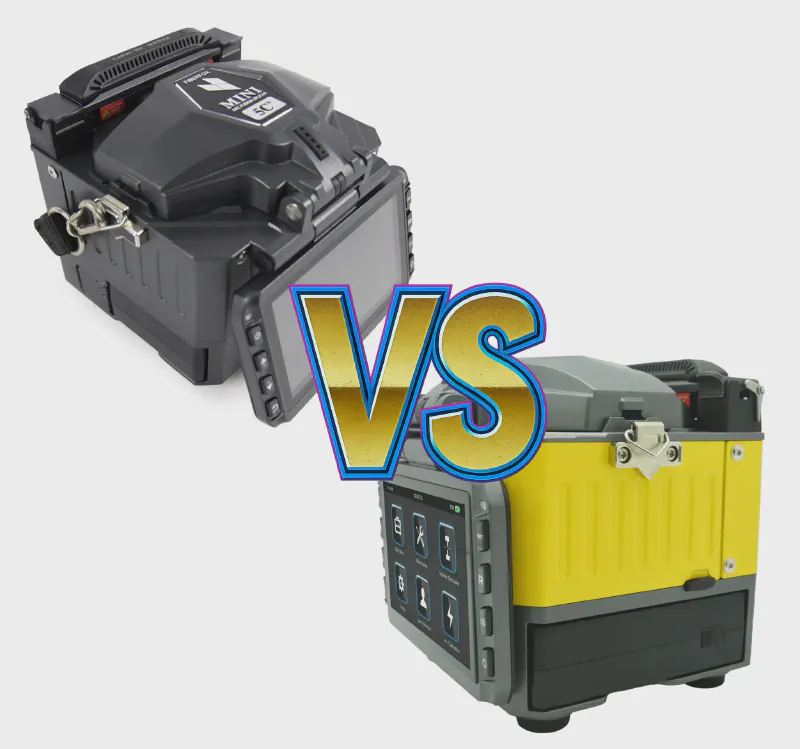
The FiberFox Mini 5C+ Premium and the FiberFox Mini 4S+ sit exactly in those two camps. On the bench they look similar, with the same general footprint, the same 4.3-inch touch screen, the same battery numbers and the same look and feel. Out in the field they behave very differently, because the way the FiberFox 5C+ Premium and the FiberFox 4S+ see fibre are built on two different technologies.
The FiberFox 5C+ Premium is a true core alignment fusion splicer. It uses FiberFox’s AOCAT system to read the actual optical core and align the splice around it. That is why it delivers very low loss even when the fibre or fibre hygeine isn’t perfect. The FiberFox 4S+ is an active alignment fusion splicer, but it aligns at the cladding. It still uses the dual cameras, it still evaluates the fibre, but its reference point is the outer glass, not the optical centre. When your fibre is consistently high quality and you have proper fibre and splicer hygeine, the FiberFox Mini 4S+ works cleanly and quickly. When your fibre is inconsistent or specialty, the FiberFox Mini 5C+ Premium absolutely pulls away.
There are a few things that impact how well either splicer works for you — fibre quality, cleaving, cleanliness, alignment, arc behaviour, and sleeve heating. Each of those factors impact the splice loss that ultimately lands on your OTDR trace. This guide breaks it down in plain language so you can decide where each FiberFox fusion splicer you should use.
2. The FiberFox Mini 5C+ Premium
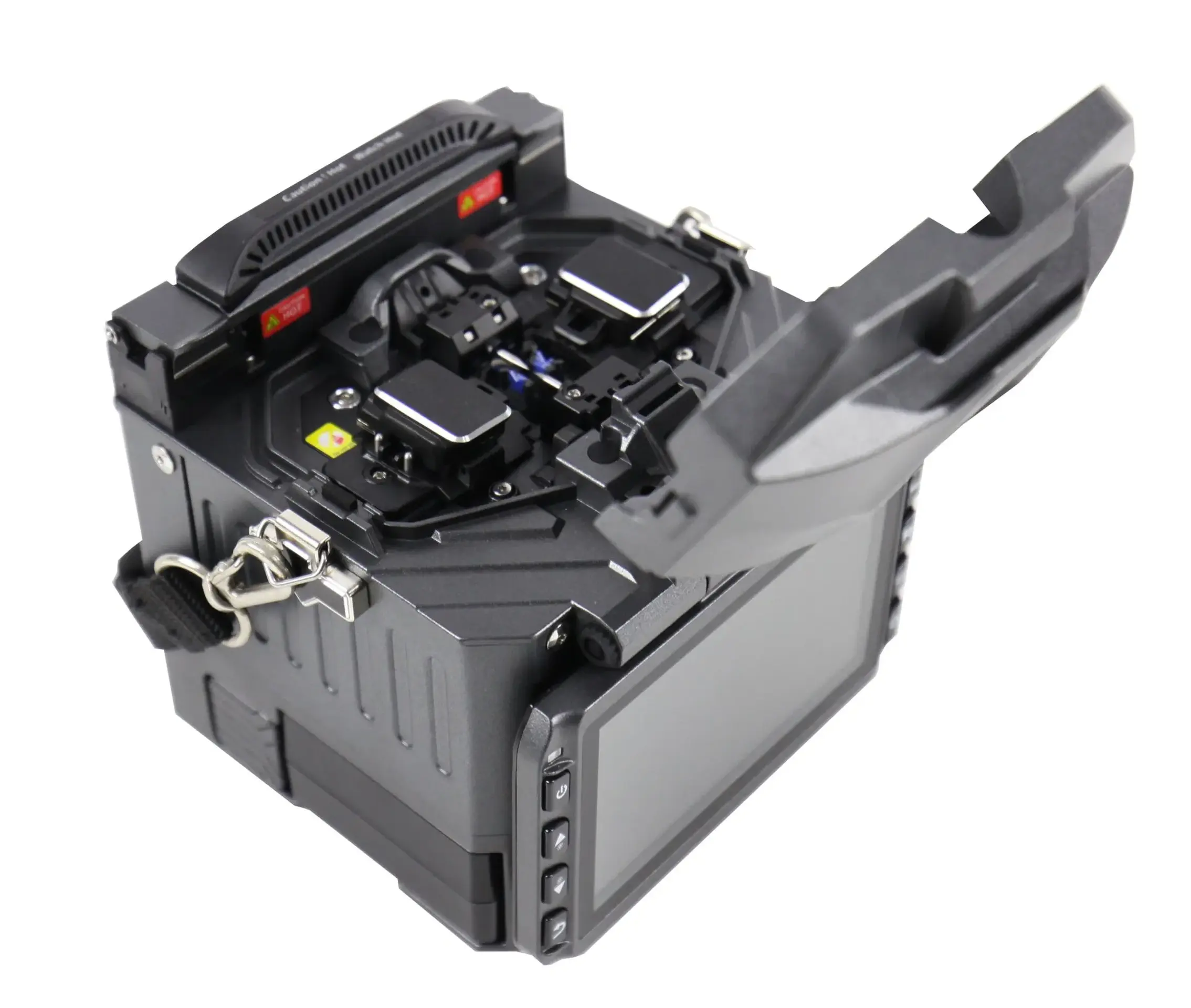 The FiberFox Mini 5C+ Premium is the kind of fusion splicer you pick when optical performance is critical. Not in the marketing sense, but in the real sense where you need splice loss to be consistent and as low-loss as possible. By imaging the core itself, the FiberFox Mini 5C+ Premium aligns the fibres around the optical centre and immediately removes the biggest source of variability, the geometry.
Core eccentricity, slight cladding distortion, batch-to-batch variation, and mixed fibre from varied suppliers are all little things that move the core by a micron or two. The FiberFox 5C+ Premium neutralises these features the best, of it because the alignment is driven by the core, not the cladding.
That’s why the FiberFox Mini 5C+ Premium sits around 0.01 dB typical on singlemode and holds strong return loss numbers. The splice looks boring on a report, which is exactly what you want from a core alignment fusion splicer.
The FiberFox 5C+ Premium weighs about 1.9 kg including the battery, and is rugged in design - it’s waterproof, dust-proof and anti-shock. The dual-CCD imaging gives a clear core view. The motors inside the 5C+ Premium move in more dimensions than the 4S+, which you can see in how the alignment behaves during the arc cycle.
Whether your fibre mix includes G.652, G.657, G.651, G.653, NZDS or even G.654, the FiberFox 5C+ Premium handles it without fuss. It aligns the actual optical path, and that is what keeps the loss predictable.
3. The FiberFox Mini 4S+
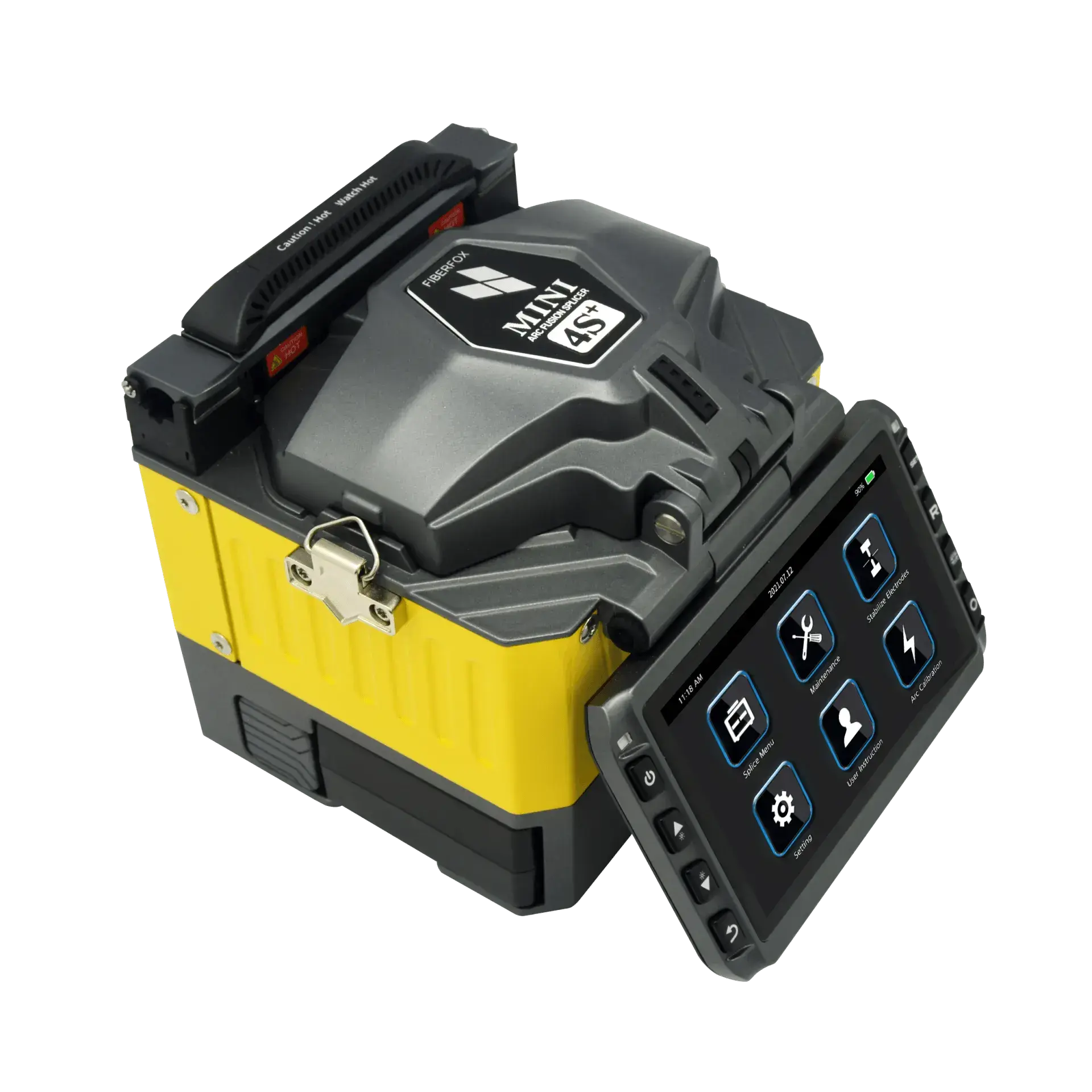
The FiberFox Mini 4S+ sits in a different position. It still uses cameras to evaluate the fibre, and it still performs a more active alignment than simply driving the V-grooves inwards. But the anchor point is the cladding. The FiberFox 4S+ locks the fibre into the V-grooves and aligns the outer glass.
When everything is uniform, with quality glass, consistent fibre types, in environments were the impact of a slightly more lossy splice is not catastrophic - like customer drops in FTTH networks - the FiberFox 4S+ delivers perfectly respectable splice numbers. Around 0.02 dB typical on singlemode, but dependant on fibre quality, cleanliness and the user’s craft and skill. Six-second splice times and ten-second sleeve cycles are not far off the 5C+ Premium. The battery life is the same 350-cycles. It feels fast, predictable, and easy to work with.
The difference is in the alignment. The FiberFox Mini 4S+ assumes core-cladding concentricity is good. When it is, the splicer behaves exactly as you want. When it doesn’t — mixed fibre types, aged fibre, or poor concentricity — the FiberFox 4S+ cannot compensate because it never saw the core. The core drifts a little and the splice loss increases because of it.
4. How Each FiberFox Splicer Aligns Fibre
When you place two fibres in a fusion splicer, a good machine doesn’t just shove them together. It evaluates them, adjusts its splicing program, and builds its own model of what the splice should look like.
Both the Mini 5C+ Premium and the Mini 4S+ feature dual CCD cameras (although the 5C+ features additional zoom). However, they each use a different alignment technology. The 5C+ uses illumation to look “through” the fibre, identifying the actual fibre core. The AOCAT (Automatic Optical Core Analysis & Tracking) technology performs some rigorous analysis of the fibre type and geometry in order to minimise the splice loss. In contrast, the 4S+ just evaluates the outside of the cladding without any reference to the actual core.
With the FiberFox Mini 5C+ Premium, six motors provide granular control over the specific fibre alignment. On the other hand, the FiberFox Mini 4S+ uses only four motors, which limit the movement during the alignment phase.
Cleaning practices will expose the difference between the two technologies. The FiberFox Mini 5C+ Premium has a margin for error, and a speck of dust or contamination can be worked around by the AOCAT core alignment technology. The FiberFox Mini 4S+ does not have the same margin, and contamination is much more likely to impact the splice.
In a similar way, the core-cladding concentricity of the fibre is impactful to the splice loss in different ways. Good quality fibre has good concentricity, whilst poor fibre may have a core that is not concentric with the cladding. The FiberFox Mini 5C+ Premium is able to compensate for these differences, whilst the FiberFox Mini 4S+ is not. If you are seeking the best splice loss possible, the FiberFox Mini 5C+ is the best choice. If you’re comfortable that some splices will be more lossy, the FiberFox Mini 4S+ is still a very capable machine.
5. What This Means for Splice Loss
The FiberFox Mini 5C+ Premium is built for low splice loss across wide variation.
The FiberFox Mini 4S+ is built for good splice loss under controlled variation.
The FiberFox Mini 5C+ Premium hits 0.01 dB typical on singlemode because it aligns the optical core. It doesn’t matter if you splice G.652 to G.657 or if your fibre comes from different factories. As long as the cleave is sound, the splice performance is the best you will be able to acheive.
The FiberFox Mini 4S+ usually sits around 0.02 dB on singlemode when the fibre is uniform. That is perfectly good for many installations.
Imperfect fibre geometry or contamination is where the two diverge. As described earlier, a number of factors make the FiberFox Mini 5C+ Premium perform better in the real world. That said, the FiberFox Mini 4S+ will still deliver very good splices - but you will see a wider variation, particularly under those real world conditions.
If you are splicing directly to connectors, both units pair well with the Splice-On Connector line, but the FiberFox 5C+ Premium will hold lower loss when the connectorised fibre varies between batches.
6. Where Each FiberFox Splicer Belongs
Backbone builds, long single mode links, and critical data centre links suit the FiberFox Mini 5C+ Premium. That is the environment where a core alignment fusion splicer earns its keep.
Less critical environments, like last-mile FTTH networks and structured cabling suit the FiberFox Mini 4S+. High volume with less strict requirements mean the more cost-effective FiberFox Mini 4S+ is a good choice.
If you ever step into ribbon work, neither of these is the tool; instead, look at the FiberFox 12R+ ribbon mass fusion splicer.
It’s really not about which FiberFox fusion splicer is “better.”, it’s about which one is best for your use case.
7. Choosing Between Them
Once you understand the alignment method, the choice becomes simple. The FiberFox Mini 5C+ Premium is the splicer that preserves optical headroom. It maintains low loss even when the fibre is inconsistent, the environment is sub-optimal, or the geometry is not quite perfect. Any job that depends on predictable optical behaviour and low-loss falls squarely in its territory.
The FiberFox Mini 4S+ is the productivity tool for high volume, less critical work. When the fibre is uniform and the work repeats, it delivers fast, stable splices without the cost or complexity of core alignment. Crews working through large batches of customer drops or structured cabling installs gain more from its lower upfront cost than from the extra precision they will never use.
That is the real decision point: optical loss versus upfront cost. Pick the one that aligns with the realities of the job, and both machines perform exactly as they were designed to.
8. Final Thoughts
The FiberFox Mini 5C+ Premium and the FiberFox Mini 4S+ represent two different answers to the same problem. Networks are a mix of performance needs, and not every network is the same. Instead of forcing one splicer to straddle both worlds, ScaleFibre offers two FiberFox machines that lean into two different priorities.
To speak to ScaleFibre about FiberFox fusion splicing or any other fibre requirement, please reach out to us at sales@scalefibre.com